Why plan the whole year
Most budgets break on the months that are not average: car insurance twice a year, a summer trip, December gifts, a tax refund in April. Plan 12 months at once and those months stop being surprises.
Step 1: set the monthly base
For each category, write what it normally gets every month: rent, utilities, groceries, debt payments, savings, fun. In the example, take-home pay is $4,300 a month plus $400 of side income, and the monthly base for spending, saving and debt is $4,505.
Step 2: override the months that are different
| Category | Normal month | Different months |
|---|---|---|
| Car insurance | $0 | March and September: $540 |
| Travel | $0 | July: $1,600 |
| Gifts and holidays | $30 | November $200, December $700 |
| Other income | $0 | April tax refund $1,200, December bonus $1,000 |
The year now plans $58,600 of income against $57,580 of spending, saving and debt: $1,020 left over. March, July and September plan to spend more than they bring in, and that is fine because the year balances.
Step 3: track actuals by month
Log income and spending as the year goes and add them up by category and month. Compare only finished months with the plan; the current month is not over yet.
Step 4: forecast the year-end
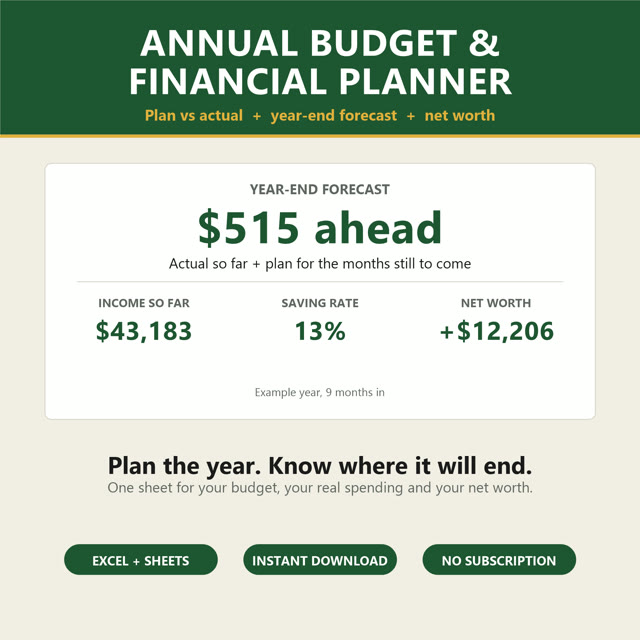
The most useful number in a yearly budget is the forecast: what you actually did in the finished months, plus your plan for the months still to come. In the example, nine months in:
| Plan | Actual / forecast | |
|---|---|---|
| Income, January to September | $43,500 | $43,183 |
| Spending, saving and debt, January to September | $43,225 | $43,413 |
| Year-end left over | $1,020 | $515 forecast |
The year is still on course to end ahead, but $505 short of the plan: income is $317 behind and spending $188 over. The category view shows where: the trip cost $1,797 against $1,600, dining out is $238 over plan and home repairs $80 over, partly offset by categories that came in under. That is the moment to act, in September, not after the holidays.
Step 5: watch your net worth once a month
Budgets track flows; net worth tracks the result. Once a month, write down what you own (checking, savings, retirement, car value) and what you owe (cards, loans). In the example, net worth rose from $4,402 in January to $16,608 by September, about $1,500 a month from saving and paying debt down.
Monthly or yearly?
Use both. The monthly budget decides where this month's paychecks go; the yearly plan makes sure each month fits the year. Check your monthly split with the 50/30/20 budget calculator and your goals with the savings goal calculator.