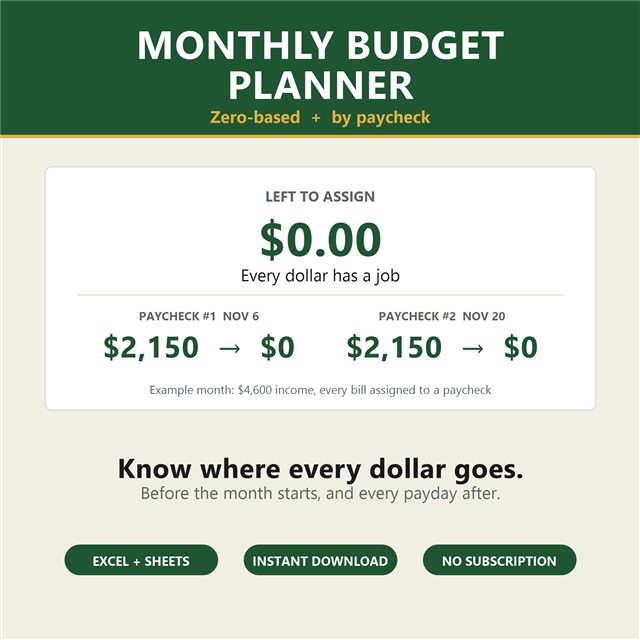
What "zero-based" means
Take the money you will bring home this month. Subtract every planned bill, spending line, saving goal and debt payment. When the answer is exactly $0, the budget is done. Money you plan to save still counts: it has a job. What you avoid is a pile of unassigned money that quietly disappears.
Step 1: list income by paycheck, not by month
Most people are not paid once a month. Write down each paycheck with its date and take-home amount. Here is a sample month:
| # | Source | Pay date | Amount |
|---|---|---|---|
| 1 | Paycheck | Nov 6 | $2,150 |
| 2 | Side gig | Nov 14 | $300 |
| 3 | Paycheck | Nov 20 | $2,150 |
| Total | $4,600 |
Step 2: give every dollar a job
List every line: rent, utilities, groceries, car, insurance, debt payments, savings, and the fun money too. Keep adding until "left to assign" reaches $0. In the sample, the full $4,600 is planned like this:
| Type | Planned | % of income |
|---|---|---|
| Needs (rent, utilities, groceries, car, insurance, minimum payments) | $3,120 | 68% |
| Wants (dining out, subscriptions, clothing, fun) | $450 | 10% |
| Savings and extra debt payments | $1,030 | 22% |
| Left to assign | $0 |
Needs are well over the 50% in the 50/30/20 guideline here, which is common where rent is high. Zero-based budgeting does not care about the percentages; it cares that every dollar is planned. You can check your own split with the free 50/30/20 budget calculator.
Step 3: assign each bill to the paycheck that pays it
This is the step most budgets skip. The first paycheck gets rent, half the groceries and the emergency fund transfer, lines that add up to its $2,150. The side gig gets an extra debt payment and the holiday fund. The second paycheck gets everything else. Now each paycheck has its own zero, and you know what must stay in the account until the next payday.
Step 4: watch for bills due before payday
Rent is due on the 1st, but the first paycheck lands on the 6th. On paper the month balances; in the bank account, rent bounces. Fix it one of three ways: pay rent from the last paycheck of the previous month, keep a one-month buffer in checking, or ask to move the due date.
Step 5: track, then adjust
Log what you spend against each line. When a line runs over, move money from another line so the budget still balances to $0. If dining out runs $22 over its $150 line, take the $22 from entertainment, not from savings.
Common mistakes
- Budgeting gross pay. Use what actually lands in your account.
- Forgetting irregular bills. Car insurance every six months, gifts in December. Give them a monthly sinking-fund line.
- No fun money. A budget with $0 for wants gets abandoned by week two.