How to price a mobile detailing job
Most detailers price from a menu they copied from a competitor and adjust by feel when the car turns out to be a filthy three-row SUV. The menu is fine as a starting point. The problem is that the menu does not know what your hour costs, how far you drove, or that the "quick interior" had a dog in it for six years. The method below prices from your cost, and it takes about a minute per vehicle.
1. Know what one hour of you in the van costs
Not your wage. Your wage plus payroll burden, plus the van per hour, plus equipment per hour, plus your overhead spread over the hours you actually bill.
| Pay yourself $25/hr + 15% burden | $28.75 |
| Van or trailer per hour (payment, insurance, fuel, upkeep) | $7.00 |
| Equipment per hour (polisher, extractor, generator, pressure washer) | $4.50 |
| Overhead: $1,100/month ÷ 120 billable hours | $9.17 |
| True cost per detailing hour | $49.42 |
|---|
Pay yourself a real wage in that first line. Owner time that costs nothing is how a detailing business looks profitable right up until you try to hire someone.
2. Size and condition multiply the hours
A full interior on a sedan is 2.5 hours. The same service on a large SUV in heavy condition is 2.5 × 1.4 × 1.5 = 5.25 hours. If you charge the sedan price you just gave away three hours. Multipliers keep this honest without a separate menu for every vehicle.
| Size | × | Condition | × |
|---|---|---|---|
| Coupe or sedan | 1.00 | Light: regularly maintained | 1.00 |
| Crossover or small SUV | 1.15 | Average: daily use | 1.20 |
| Pickup truck | 1.25 | Heavy: ground-in dirt, stains | 1.50 |
| Minivan or van | 1.30 | Extreme: pet hair, smoke, spills | 2.00 |
| Large SUV or three-row | 1.40 |
Ask two questions on the phone: what is the vehicle, and when was it last detailed. Those two answers set both multipliers before you see the car.
3. Count the drive
Mobile means you bring the shop to the car. The drive is your paid time in a van that costs money per hour and per mile. Add drive hours to the job before you price it, and add mileage at 60 to 70 cents. A $300 job 40 minutes away and a $300 job 10 minutes away are not the same job.
4. Chemicals are small, add-ons are not
Chemicals on a full detail run $15 to $30 once they are diluted correctly (the chemical cost calculator shows why the bottle price is misleading). Add-ons are where the time hides: pet hair is an hour, a one-year ceramic coating is two and a half hours and $65 of product. Price each add-on as hours plus chemicals, not as a flat "plus $40".
5. Divide by one minus the margin
Worked example
Complete inside and out on a crossover in average condition, with pet hair removal. 45 minutes of driving, 22 miles round trip.
| Service hours: 3.5 × 1.15 × 1.2 | 4.83 |
| + pet hair 1.0, + drive 0.75 | 6.58 door-to-door hrs |
| Labour, van, overhead: 6.58 × $49.42 | $325.16 |
| Chemicals (16 × 1.38) + 3 | $25.08 |
| Water, power $4; mileage 22 × $0.68 | $18.96 |
| Total job cost | $369.20 |
|---|---|
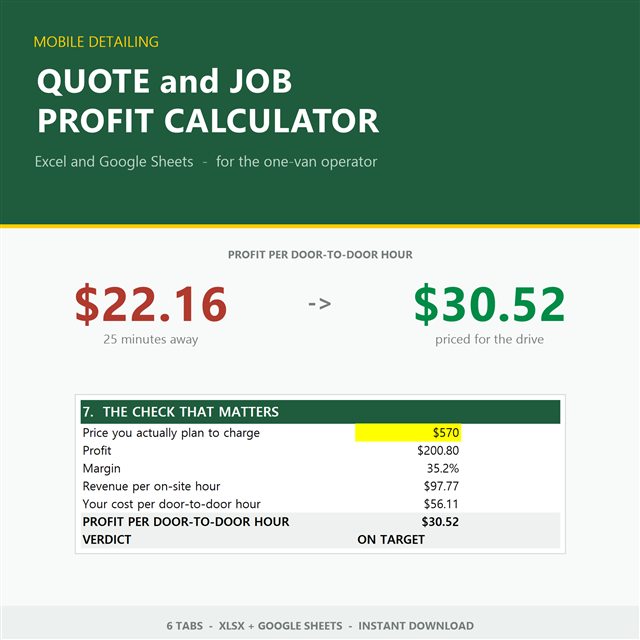
| Quote at 35% margin, rounded up to $5 | $570 |
| Revenue per on-site hour | $97.77 |
| Profit per door-to-door hour | $30.52 |
A menu price of $350 for "full detail, SUV" earns a 5% margin on this car. One extra hour of dog hair and you paid to do it.
The number to watch
Profit per door-to-door hour. Not revenue, not margin. A big-ticket job across town can earn less per hour of your day than a quick wash next door. When the calendar is full, take the jobs with the highest number and let the others go.
Frequently asked questions
How much should a mobile detailer charge per hour?
A solo operator with a van costs $45 to $60 an hour to run once wage, burden, van, equipment and overhead are counted. The rate needs to be $75 to $100 per on-site hour to keep a 30% to 35% margin. Quote by the job; build it from hours.
How much does a full inside-and-out detail cost?
A sedan in average condition typically prices $250 to $400 from a mobile detailer. A large SUV in heavy condition can be $500 to $700 because size and condition multiply the hours.
Should I charge for drive time?
Build it into the price. Add drive hours and mileage to the job cost, then apply your margin. Watch profit per door-to-door hour, which punishes far jobs the way your day does.
What margin should a detailing business make?
30% to 35% net on quoted work, after paying yourself a wage, is healthy for a solo mobile operation. Posted menu prices need a higher margin (40%) because you cannot adjust them after seeing the car.
Every default in the calculator is a placeholder. Wages, van costs, chemical prices and drive distances vary by market and by operator. Replace them with your own numbers. This tool does not provide legal, tax, insurance or accounting advice.