What detailing chemicals really cost, per ounce and per car
Detailers argue about product the way cooks argue about knives, and almost always about the wrong number. The number on the shelf is what a bottle costs. The number that matters is what an ounce costs once it is on the car, and the two are separated by dilution, which can be a factor of a hundred.
1. The only formula you need
Cost per RTU ounce = price ÷ RTU ounces.
A $24 gallon of all-purpose cleaner at 10:1: 128 × 11 = 1,408 ounces. $24 ÷ 1,408 = 1.7 cents per ounce.
Now the same arithmetic on car shampoo at 128:1: 128 × 129 = 16,512 ounces from one gallon. $28 ÷ 16,512 = 0.17 cents per ounce. And a $28 quart of leather conditioner used neat: 32 ounces, 88 cents per ounce. Three bottles at roughly the same price; a five-hundred-fold spread in what an ounce costs.
2. A typical shelf
| Product | Bought | Dilution | Cost / RTU oz | Oz per car | Cost / car |
|---|---|---|---|---|---|
| All purpose cleaner | $24 / gal | 10:1 | $0.017 | 8 | $0.14 |
| Wheel and tyre cleaner | $32 / gal | 4:1 | $0.050 | 6 | $0.30 |
| Car shampoo | $28 / gal | 128:1 | $0.002 | 16 | $0.03 |
| Interior cleaner | $22 / gal | 4:1 | $0.034 | 10 | $0.34 |
| Leather conditioner | $28 / qt | neat | $0.875 | 2 | $1.75 |
| Polish and compound | $42 / qt | neat | $1.313 | 1.5 | $1.97 |
| Total, plus 10% waste | ≈ $4.98 | ||||
Five dollars of chemicals on a four-hour detail. The dearest bottle on the shelf (the compound) is also the dearest per car, but at two dollars. The shampoo you are tempted to upgrade costs three cents a car.
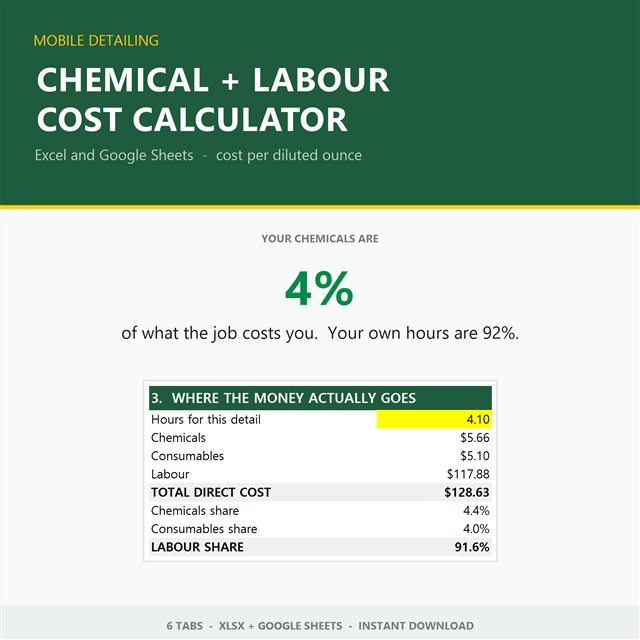
3. Chemicals are 4% of the job. Labour is 92%.
On a 4.1-hour detail at a loaded $28.75 an hour, labour is $118. Chemicals are $5. Consumables (towels, pads) are another $5. Switching to a chemical that is twenty percent cheaper saves you a dollar. Shaving fifteen minutes off the process saves you seven. Every hour you spend comparing products is worth more spent on your process.
The exception is coatings and compounds, where product is genuinely expensive per ounce and per car. Price those as line items on the quote; do not average them into a package.
4. Where the money really leaks
- Dilution by eye. A 10:1 product mixed at 4:1 costs two and a half times as much per ounce and often works worse. Use a measuring cup or a dilution sprayer.
- Mixing a gallon, using a pint. Diluted product in an open bucket degrades. Mix what the day needs.
- Buying quarts of what you use by the gallon. Same product, often 30% to 40% more per ounce in the small size.
- Consumables you never count. A $2 towel that lasts 40 washes is five cents a use; a $12 pad that lasts five cars is $2.40. Pads are the consumable to watch.
5. Vehicles per bottle tells you when to restock
Divide RTU ounces by ounces per vehicle. A gallon of shampoo does a thousand cars. A quart of leather conditioner does sixteen. If you detail forty cars a month, the conditioner runs out every twelve days and the shampoo lasts two years. Restock by vehicles per bottle, not by looking at the shelf.
Frequently asked questions
How do you calculate the cost of a diluted chemical per ounce?
Ready-to-use ounces = container ounces × (dilution parts + 1). Cost per RTU ounce = price ÷ RTU ounces. A $24 gallon at 10:1 makes 1,408 ounces at 1.7 cents each.
How much do chemicals cost per car detail?
Correctly diluted, $4 to $8 per vehicle for a standard detail including a 10% waste allowance. Coatings and compounds push it higher. Chemicals are usually under 5% of direct cost.
Is a more expensive chemical worth it?
Compare cost per RTU ounce and cost per vehicle, not bottle price. Then ask whether it saves time; a product that saves ten minutes a car is worth more than any saving on the bottle.
What should I charge for chemicals?
Nothing separately on standard packages; they are inside the price. Charge coatings, compounds and odour treatments as line items because their product cost is real.
Every default in the calculator is a placeholder. Product prices, dilutions and usage vary by brand and by detailer. Replace them with your own numbers. This tool does not provide legal, tax, insurance or accounting advice.