Four things ride on every hour
| Layer | What it is | Example |
|---|---|---|
| Your wage, loaded | Pay yourself a real hourly wage, plus 15% for tax, insurance and cover | $25 × 1.15 = $28.75 |
| Van or trailer | Payment, insurance, fuel, tires, upkeep, spread over the hours it is out | $7.00 |
| Equipment | Polisher, extractor, generator, pressure washer, water tank, replaced every few years | $4.50 |
| Overhead | Phone, booking software, insurance, marketing, accountant, spread over billable hours | $1,100 ÷ 120 hrs = $9.17 |
| True cost per detailing hour | $49.42 | |
If you have been mentally pricing at $25 an hour, half of your cost was invisible. That is why a "$150 interior" that took three hours felt fine and the bank balance did not agree.
Pay yourself first, on paper
The single most common mistake in solo detailing is a wage of zero. The business looks profitable because the owner's time costs nothing. Then the owner tries to take a week off, or hire a helper at $18 an hour, and discovers every job was priced below what a paid person costs. Put a wage in the first line and price off it, even if you are the one taking it home.
Billable hours are fewer than you think
You do not bill eight hours a day. You bill the hours with a car in front of you. Driving, quoting, restocking, rinsing the tank, waiting on a no-show: paid to nobody. A busy solo detailer bills 100 to 140 hours a month. Divide overhead by that number, not by 160, or every hour is under-allocated.
From cost to rate
You will rarely quote hourly; customers want a job price. But every job price should be hours times this rate plus chemicals and mileage. The pricing calculator does exactly that with size and condition multipliers.
The number to watch each week
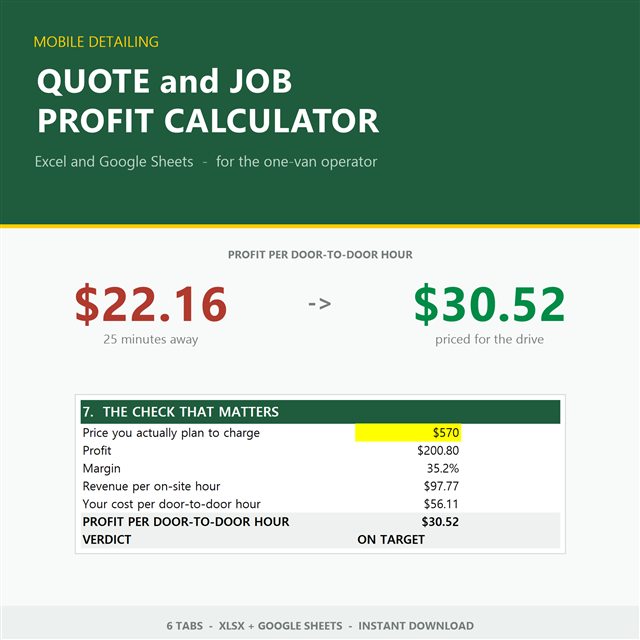
Profit per door-to-door hour. Take the week's revenue, subtract chemicals, mileage and water, subtract your true cost for every hour from leaving the yard to getting back, and divide by those hours. If it is under $20, the menu is too cheap or the drives are too long. If it is over $40, you can afford to be pickier about jobs.
Three fast fixes
- Cluster the day by area. Two jobs ten minutes apart beat two jobs forty minutes apart at the same price. The drive is your biggest controllable cost.
- Ask condition on the phone. "When was it last detailed, any pets or smokers?" sets the condition multiplier before you commit to a number.
- Recalculate the true cost quarterly. Fuel moves, insurance renews, you buy a better extractor. The rate that was right in spring is wrong by fall.