How to set an hourly rate for a crew business
Ask ten tree service owners what they charge an hour and you get ten numbers. Ask them how they got the number and most will say some version of "that's what everyone charges." That is not a rate. It is a guess about someone else's guess. Your rate has to come from your costs, because your costs are the only thing you can actually know.
There are four pieces: what the crew costs, how many hours you can really bill, what the iron costs, and what the business costs whether or not you work. Put them together and you get a break-even rate. Add the margin you want to keep and you get the rate you charge.
1. Wages are the small part
A $25 wage is not a $25 cost. On top of every wage dollar sits the employer share of payroll taxes (roughly 9%), workers compensation (tree work is one of the highest-rated classes in the country, often 12% to 20%), and the part of your liability insurance that is rated on payroll. Add a few dollars an hour for uniforms, training and paid time off accrual.
2. You pay for 2,000 hours. You bill far fewer.
This is the step almost everyone skips, and it is the biggest one. A full-time crew member is paid roughly 2,000 hours a year. Take out holidays, sick days, and the days it rained or there was no work booked. Then take out the share of the remaining hours spent at the shop, driving to jobs, sharpening, fixing the chipper, and going for fuel. What is left is the hours a customer pays for.
| Paid hours per year | 2,000 |
| Less 25 paid days with no billing (× 8 hrs) | −200 |
| Less 18% shop, travel and maintenance | −324 |
| Billable hours per year | 1,476 |
|---|---|
| Utilization | 73.8% |
Every billable hour has to carry the cost of the unbillable ones. Divide the burdened cost per paid hour by utilization and you get the real cost per billable hour: $33.25 ÷ 0.738 = $45.05. For a three-person crew that is $135 per hour on site, before any equipment.
3. Iron costs money parked
A chipper has two kinds of cost. Ownership is what it costs whether it runs or not: the payment or the depreciation, insurance, registration. Operating is what it costs once it is running: fuel, blades, servicing, repairs. Divide both by the hours you actually use it in a year and you get a cost per hour. A $42,000 chipper used 700 hours a year is about $24 an hour all-in. A chip truck is about $30. Saws, ropes and small gear add another $7. A typical rig lands at $55 to $70 per hour.
Only count the machines that leave the yard on an average job. The bucket truck that goes out one job in four should be priced onto those jobs, not spread across every hour.
4. Overhead is everything you pay whether or not you work
Yard rent, phone, software, accounting, licenses, advertising, the truck you drive to estimates, card fees. And the biggest line most owners leave out: your own time off the truck. Quoting, scheduling, chasing invoices, buying parts. If you do not pay yourself for those hours, the jobs never carry them and your business is being subsidized by free labor.
5. Add it up: the break-even rate
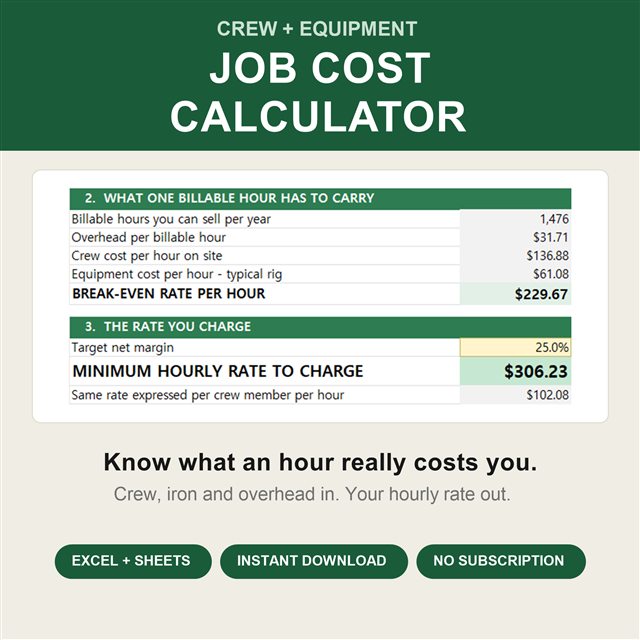
| Crew cost per hour on site (3 × $45.05) | $135.16 |
| Equipment, typical rig | $61.00 |
| Overhead per billable hour | $31.71 |
| Break-even rate per crew hour | $227.87 |
|---|
Charge this and you go home with nothing. It is the floor, not the price.
6. Margin, not markup
You want to keep 25%. The instinct is to add 25% to $228 and charge $285. But $57 of profit on a $285 price is a 20% margin, not 25%. You just gave away a fifth of your profit by doing the arithmetic in the wrong direction.
If that number feels high, it is because you have been comparing it to wages. Wages are a third of it. The rest is the cost of running a business that shows up with three people and a rig and does the job safely.
What to do with the number
- Quote jobs from hours. Estimate crew hours, multiply by your rate, add job-specific costs like dump fees and permits. The tree service pricing calculator does exactly that.
- Raise utilization before raising prices. Every point of utilization drops your cost per billable hour. Tighter routing, fewer shop mornings, and estimating on the way home are worth more than a 5% price increase.
- Revisit it twice a year. Comp rates change, fuel changes, and you buy iron. The rate that was right in March is wrong in September.
Frequently asked questions
How much should a tree service charge per hour?
A three-person crew with a chip truck and chipper typically needs $250 to $350 per crew hour to cover loaded wages, unbillable time, equipment and overhead with a 20% to 30% margin. Calculate it from your own costs.
What is utilization?
The share of paid hours a customer pays for. 1,476 billable out of 2,000 paid is 74%. Every billable hour carries the unbillable ones.
Why is a 25% markup not a 25% margin?
Markup is added to cost; margin is a share of price. A 25% markup on $228 gives $285, which is a 20% margin. To keep 25% you divide by 0.75 and charge $304.
Should I include my own salary in overhead?
Include the hours you spend off the truck: quoting, admin, chasing money. If you also work on the crew, count those hours as crew cost at a wage. Both have to be in the rate or the business is paying you nothing for one of them.
Every default in the calculator is a placeholder. Burden, comp rates, equipment costs and overhead vary by state and by business. Replace them with your own numbers. This tool does not provide legal, tax, insurance or accounting advice.