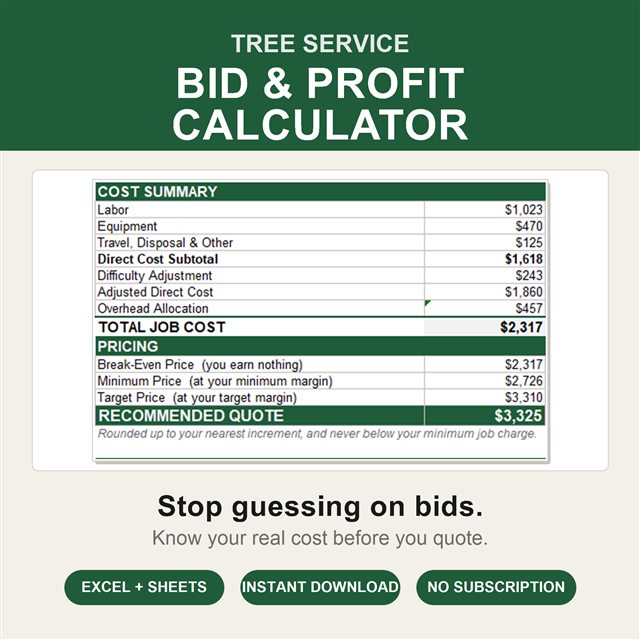
How to price a tree service job
Most tree services price by feel. You look at the tree, think about the last similar job, and say a number. Sometimes that works. But if you have ever finished a job, paid the crew, paid the dump, and wondered where the money went, the problem is not your work. It is that the number never started from your cost.
This guide walks through the same method the calculator above uses. It takes ten minutes to learn and it will change how you look at every bid.
1. What a tree job actually costs
Every job has five cost buckets. Miss one and your quote is wrong before you start.
| Bucket | What goes in it | Typical share |
|---|---|---|
| Labor | Every person-hour on site plus drive time, at the loaded rate | 40–55% |
| Equipment | Bucket truck, chipper, stump grinder, crane, chip truck, by the hour | 15–25% |
| Travel & disposal | Fuel for every vehicle, dump fees, permits, traffic control | 5–10% |
| Difficulty | Extra time and risk from access, obstacles, structures, power lines | 0–60% of direct cost |
| Overhead | Insurance, office, licenses, ads, software, loan payments, spread across jobs | 15–25% |
Labor and equipment are the ones everybody counts. Overhead and difficulty are the ones that quietly eat the margin.
2. Use a loaded labor rate, not the wage
If you pay a climber $45 an hour, that climber does not cost you $45 an hour. Add payroll taxes, workers compensation and liability insurance and the real number is closer to $60. Tree work carries some of the highest workers comp rates of any trade, so the burden is often 30% to 45% on top of the wage.
The calculator asks for one blended loaded rate for the whole crew. If your climber is at $60 and two ground workers are at $38, the blend is about $45. The full spreadsheet keeps each role separate.
3. Put overhead on every job
Your insurance, yard rent, phone, website, software and truck payments do not stop when the crew is on a job. They are part of the job. The clean way to include them is an overhead rate per crew hour.
Billable crew hours means hours on paid jobs, not hours at the shop or driving to estimates. Most small crews are surprised how low that number is. That is exactly why the overhead rate matters.
4. Charge for difficulty, not just for size
Two oaks of the same size are not the same job when one is in an open field and the other is over a garage next to a service drop. Rigging, lowering every piece, and working around a structure can double the time and the risk. Pricing this with a gut feel is how you end up doing the hard job for the easy price.
A difficulty multiplier applied to direct cost keeps this honest:
| Level | Site conditions | Multiplier |
|---|---|---|
| 1 · Easy | Open drop zone, clear access, nothing to hit | 1.00 |
| 2 · Moderate | Some obstacles, fence or landscaping to protect | 1.15 |
| 3 · Difficult | Close to structures, tight access, rigging required | 1.35 |
| 4 · Extreme | Power lines, over roof, crane or technical removal | 1.60 |
These are starting points. If your crew consistently runs over on level 3 jobs, raise the multiplier. That is a business decision the numbers will tell you over time.
5. Margin is not markup
This is the single most expensive mistake in trade pricing, and it hides in plain sight.
Say a job costs you $1,000 and you want to make 30%. Most people add 30% and quote $1,300. But $300 profit on a $1,300 price is a 23% margin, not 30%. You just gave away a quarter of the profit you thought you were earning.
The calculator does this correctly every time. When you set 30%, you get 30%.
6. Watch revenue per crew hour
Total price is the number the customer sees. Revenue per crew hour is the number you should see. Two jobs at $3,000 are not equal if one takes 20 crew hours and the other takes 30. The first pays $150 per crew hour, the second $100. When your schedule is full, you should be taking the $150 jobs and letting the $100 jobs go to someone else.
Over a season, this one metric tells you which kinds of work to chase and which to price up or drop.
7. Round up and set a floor
A quote of $3,284 looks like it came from a calculator, which it did. $3,300 looks like a professional who knows the value of the work. Round up to a clean increment, $25 or $50, and never send a quote below your minimum job charge. Showing up with a crew and a truck costs money before the first cut. For most tree services the floor is $300 to $500.
Worked example
Remove two dead oaks near a driveway, chip and haul, grind two stumps. Three-person crew, six hours on site, ninety minutes of drive time round trip. Chipper four hours, stump grinder two hours, chip truck six hours. Fence and landscaping to protect.
| Labor: 22.5 crew hours × $45 loaded | $1,012.50 |
| Equipment | $470.00 |
| Fuel, dump fees | $125.00 |
| Difficulty level 2 (+15% of direct cost) | $241.13 |
| Overhead: 22.5 crew hours × $20 | $450.00 |
| Total job cost | $2,298.63 |
|---|---|
| Target price at 30% margin (÷ 0.70) | $3,283.75 |
| Recommended quote (rounded up to $25) | $3,300 |
A bid of $2,600 on this job, which many crews would send, earns $301 for three people and a full day of equipment. That is an 11.6% margin and $13 of profit per crew hour. The calculator's reality check will tell you that before the customer does.
Common mistakes
- Forgetting drive time. Ninety minutes round trip for three people is 4.5 crew hours. At a loaded $45 that is $200 you paid and did not bill.
- Pricing equipment at fuel cost. A chipper costs fuel, blades, maintenance and the payment. $35 to $50 an hour is realistic. $10 is not.
- Copying a competitor's price. You do not know their costs. If they are underpricing, you are now underpricing with them.
- Discounting the difficult jobs to win them. The difficult jobs are where the risk is. They should carry the highest margin, not the lowest.
- Never checking quoted vs. actual. If you do not log what the job really took, every multiplier stays a guess forever.
Frequently asked questions
How much should I charge for a tree removal job?
Start from your cost, not from a market average. Add loaded labor, equipment hours, fuel and dump fees, then overhead per crew hour and a difficulty multiplier, and divide by one minus your target margin. A three-person crew removing two medium trees typically lands between $2,500 and $4,000 depending on region and access.
What is a reasonable profit margin for a tree service?
A net margin of 15% to 30% after all costs including overhead is healthy for a small crew. Below 15% one bad month wipes out the year. Above 30% is possible on technical work where few competitors can bid.
Should I charge by the hour or by the job?
Quote by the job. Customers want a number, and hourly pricing punishes you for being fast. But calculate the job price from hours, so the number is grounded in cost. Revenue per crew hour is how you check afterward whether the job price was right.
How do I estimate hours for a tree job?
Break the job into steps: setup, climb or bucket work, lowering, chipping, cleanup, stump grinding, haul. Estimate each step for your crew, then add 10% to 15% for the things you cannot see from the driveway. Log the actual time afterward and your estimates will tighten within a dozen jobs.
Every default in the calculator is a placeholder. Wages, insurance, fuel and dump fees vary a lot by region. Replace them with your own numbers before you bid. This tool does not provide legal, tax, insurance or accounting advice.