The short answer
For household junk, most junk removal companies charge about $30 to $65 per cubic yard, and $45 to $90 in high-cost metro areas. A full 15-yard truck usually runs $500 to $850. Small loads cost more per yard than big ones, because every job carries the same drive and dump run.
| Load | Volume | Typical price | Per cubic yard |
|---|---|---|---|
| Single item or minimum | 1–2 cu yd | $75–$150 | varies |
| 1/4 truck | 4 cu yd | $150–$275 | $38–$69 |
| 1/2 truck | 7.5 cu yd | $275–$450 | $37–$60 |
| 3/4 truck | 11 cu yd | $400–$650 | $36–$59 |
| Full truck | 15 cu yd | $500–$850 | $33–$57 |
What a cubic yard looks like
A cubic yard is a box three feet on every side. Most junk trucks hold 12 to 20 yards; 15 is the common size, and most price cards are written against it. For reference:
- A three-seat sofa: about 2 to 3 cubic yards
- A queen mattress and box spring: about 2 cubic yards
- A refrigerator: about 1.5 cubic yards
- A full-size pickup bed, heaped: about 2 to 3 cubic yards
Why per-yard pricing stops working on heavy loads
A per-yard price assumes household junk at around 150 pounds a yard. At that weight a full 15-yard truck is about 1.1 tons, roughly $71 at the 2025 national average landfill fee of $63.48 a ton. Change the material and the same space costs far more to dump:
| Material | Lb per cu yd | 15 yards weighs | Tipping at $63.48 a ton |
|---|---|---|---|
| Furniture | 120 | 1,800 lb | $57 |
| Household junk | 150 | 2,250 lb | $71 |
| Mixed construction debris | 500 | 7,500 lb | $238 |
| Roofing shingles | 2,200 | 33,000 lb | $1,047 |
| Concrete or brick | 2,400 | 36,000 lb | $1,143 |
No junk truck carries 16 tons. Most are rated for a payload of three to five. That is why heavy material is priced by weight or with a surcharge, never at the household rate. Seven yards of shingles is under half a truck and already about 7.7 tons.
Setting your own per-yard rate
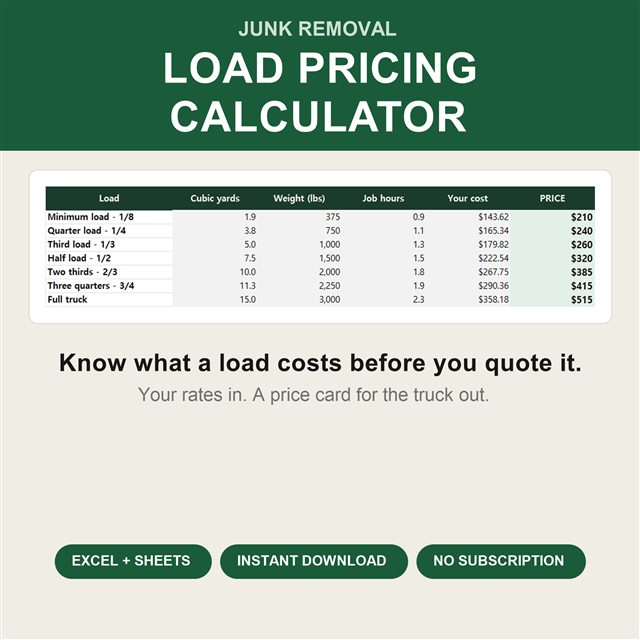
Customers compare your per-yard price to the market. Your floor has to come from your own costs: crew and truck by the hour, overhead, and disposal by weight. The price list guide builds a full price card from those costs. On its example numbers, break-even is $115.86 per job hour and the card comes out like this:
| Tier | Price | Per cubic yard |
|---|---|---|
| Minimum (1 cu yd) | $215 | $215 |
| 1/4 truck (4 cu yd) | $300 | $75 |
| 1/2 truck (8 cu yd) | $430 | $54 |
| 3/4 truck (11 cu yd) | $530 | $48 |
| Full truck (15 cu yd) | $645 | $43 |
Two things stand out. The full-truck rate of $43 a yard sits inside the market range, so the costs are realistic. The quarter truck at $75 a yard sits above it, because a small job still carries a full drive and dump run. If your quarter-truck price has to be $300 and the market pays $200, the answer is not to cut the price. It is to stack small jobs into one run.
Surcharges that sit on top of the per-yard price
- Pass-through items. Mattresses, refrigerant appliances, tires and electronics carry dump fees of their own. Charge them as line items.
- Access. Stairs, long carries and no driveway add crew time. A flat $50 to $100 is common.
- Heavy material. Concrete, dirt, shingles and tile by weight, with a payload check before you load.
The junk removal pricing calculator does the weight check and the per-yard price for a mixed load.
Common questions
Is it cheaper to pay by the item or by the yard?
For one or two items, most companies charge a flat minimum or a per-item price. Past a quarter truck, volume pricing is simpler for both sides and usually cheaper per item.
Why did the price change on the day?
Usually because the load took more space than the photos suggested, or included heavy material. A good crew shows the customer the load in the truck against the price card before collecting payment.