The sample business
The numbers below come from a sample year for a small residential cleaning business: one owner who cleans, plus a part-time helper on busy weeks, eight recurring homes, five or so deep cleans and two move-outs a month. From January to mid-October it brought in $46,875. Expenses, including the mileage deduction, were $14,913, about 32% of income.
| Expense | Jan to mid-Oct | Share of income | Schedule C line (US) |
|---|---|---|---|
| Contract cleaners (helper) | $5,130 | 10.9% | Line 11 Contract labor |
| Cleaning supplies | $2,246 | 4.8% | Line 22 Supplies |
| Mileage deduction | $1,879 | 4.0% | Line 9 Car and truck |
| Equipment (vacuums, steamers) | $953 | 2.0% | Line 22 Supplies |
| Bank and card fees | $891 | 1.9% | Line 27a Other expenses |
| Insurance and bonding | $780 | 1.7% | Line 15 Insurance |
| Phone | $650 | 1.4% | Line 25 Utilities |
| Advertising | $618 | 1.3% | Line 8 Advertising |
| Scheduling software | $490 | 1.0% | Line 27a Other expenses |
| Uniforms and laundry | $419 | 0.9% | Line 27a Other expenses |
Smaller lines made up the rest: a business license, the tax preparer, a vacuum repair, office supplies, a few business meals and one trade-show night. Your own pay is not an expense for a sole proprietor; it is what is left.
What each expense is, and what to watch
- Helpers and employees. The biggest line as soon as you are not cleaning alone. Contract cleaners go on Line 11; employees on payroll go on Line 26 Wages, with payroll taxes on Line 23. Be sure helpers are classified correctly for your state.
- Supplies. Chemicals, cloths, mop pads, gloves, trash bags, paper towels. About $1.50 per cleaning hour is typical; track it per month and it tells you when a client's home uses more than their price covers.
- Mileage. Every drive between homes and to the supply store. At 70 cents a mile, 2,700 miles was worth $1,879 here; you only get it with a log of date, trip and miles.
- Equipment. Vacuums, steam mops, caddies, ladders. Small items are usually expensed in the year you buy them.
- Insurance and bonding. General liability plus a janitorial bond. Clients increasingly ask for both.
- Card fees. About 3% of what clients pay by card. Build it into your prices rather than surcharging.
- Software, phone and advertising. Small monthly lines that add up to 4% of income here; review them once a year.
Expenses decide your prices
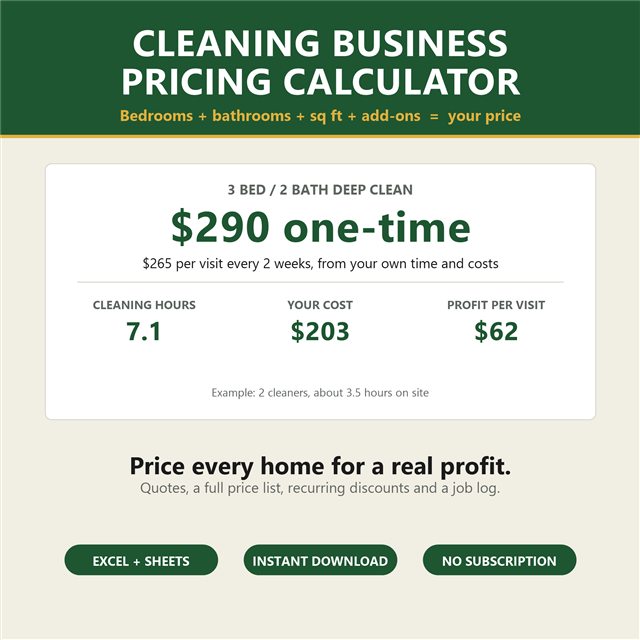
Your cost per cleaner hour is pay plus payroll burden plus supplies plus overhead divided by the hours you clean. If expenses rise and prices do not, the margin shrinks quietly. Put this year's numbers into the free house cleaning price calculator and see what a 3 bedroom, 2 bath clean needs to cost now. The method is explained in cleaning business hourly rate.
A simple way to track it
- One row per receipt: date, vendor, what for, category, amount, how you paid, receipt saved or not.
- One row per invoice: client, type of clean, amount, paid or unpaid.
- One row per business drive.
- Once a month: total each category, compare with last month, and move a share of profit into a tax savings account.
The Cleaning Business Spreadsheet Bundle does all four, with these expense categories and Schedule C lines already set up, alongside the pricing calculator.
Frequently asked questions
What are the main expenses of a cleaning business?
Helpers or employees, cleaning supplies, vehicle costs or the mileage deduction, equipment, insurance and bonding, card processing fees, phone, software and advertising. In the sample year here they came to about 32% of income.
How much does a cleaning business spend on supplies?
Typically 4% to 6% of income, or about $1.50 per cleaning hour. The sample business spent $2,246 on supplies on $46,875 of income, 4.8%.
Can I deduct mileage for driving between clients' homes?
Yes, driving between job sites and to buy supplies is business mileage. Keep a log of the date, where you drove, why and the miles. Driving from home to your first client may not count if you do not have a qualifying home office; check with a tax professional.
Is paying myself a business expense?
Not for a sole proprietor or single-member LLC. Your pay is the profit left after expenses, and it is what income and self-employment tax are figured on.
General information for US sole proprietors, not tax advice.