How to price a house cleaning job
Most new cleaners copy a price list from a competitor or charge a flat rate per bedroom. Both work until a client books a deep clean on a large home with three dogs, and the job takes twice as long as the price assumed. Pricing from time and cost takes a minute per home and tells you before you book whether the job pays.
1. Know what one cleaner hour costs you
Not the wage. The wage plus payroll burden, plus supplies, plus your monthly overhead spread over the hours your team actually cleans.
| Cleaner pay $20/hr + 12% payroll burden | $22.40 |
| Supplies (chemicals, cloths, vacuum bags, gloves) | $1.50 |
| Overhead: $450/month ÷ 140 cleaning hours | $3.21 |
| True cost per cleaner hour | $27.11 |
|---|
If you clean alone, put your own pay in the first line at the rate you would pay someone else. Owner time that costs nothing makes a business look profitable right up until you hire your first cleaner and the margin disappears.
2. Estimate the minutes, room by room
A home is a kitchen and living area plus bedrooms plus bathrooms, plus extra time for large square footage. These starting times are for one cleaner doing a standard clean in an average home. Time a few of your own cleans and replace them.
| Part of the home | Minutes |
|---|---|
| Kitchen and living area | 50 |
| Each bedroom | 20 |
| Each bathroom | 30 |
| Each 500 sq ft above 1,000 | 15 |
Then multiply for the type of clean and the condition. A deep clean takes about 1.6 times a standard clean; a move-out about 2 times. A home with built-up grime takes about 1.3 times longer; a tidy one about 0.9 times. Add-ons like the inside of the oven or fridge are added as fixed minutes on top.
3. Add travel, then divide by one minus the margin
Round up to the nearest $5 so prices look clean on a quote, and set a minimum price so a small apartment across town still covers the drive and the setup time.
Worked example
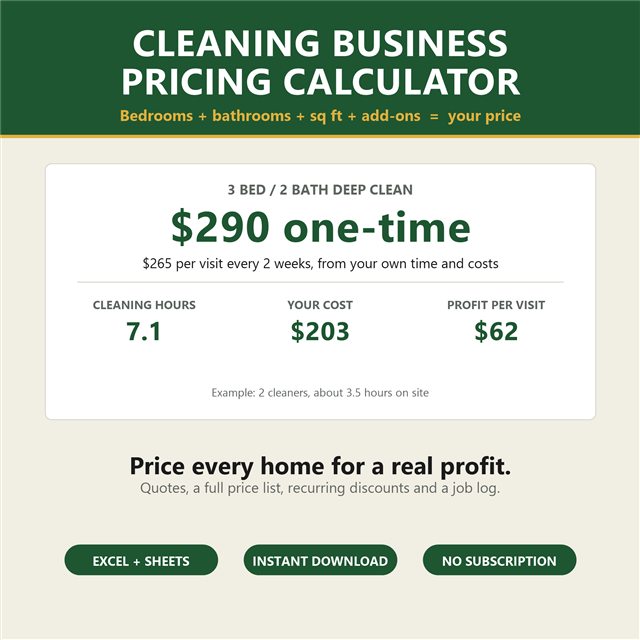
A 3 bedroom, 2 bathroom home of 1,800 sq ft. Deep clean, average condition, inside the oven and fridge and baseboards. Two cleaners, 12 miles round trip, booked every two weeks after the first visit.
| Room minutes: 50 + 3 × 20 + 2 × 30 + 2 × 15 | 200 |
| Deep clean 200 × 1.6, + add-ons 105 | 425 min = 7.08 hrs |
| Time on site with 2 cleaners | about 3.5 hrs |
| 7.08 hrs × $27.11, + materials $2.50, + travel 12 × $0.70 | $202.96 |
| One-time price at 30% margin | $290 |
|---|---|
| Every 2 weeks, 10% off, rounded up to $5 | $265 |
| Margin at $265 if the visit still takes 7 hours | 23% |
That last line is the trap with recurring discounts. The discount is only safe because a home cleaned every two weeks is quicker to clean. Price the recurring visit from a standard clean, not from the first deep clean, and check the margin again.
The number to watch
Profit per cleaning hour. Two homes at the same price can earn very different amounts per hour of your team's time. Log what you charged and how long each clean really took; the homes that run long are the ones to re-quote.
Frequently asked questions
How much should I charge to clean a house?
Price from hours, not from a competitor's flyer. Estimate the minutes for the home, multiply by your true cost per cleaner hour, add travel, then divide by one minus your target margin. A 3 bedroom, 2 bathroom standard clean usually lands between $140 and $250 depending on local wages and the size of the home.
How much more should a deep clean cost than a standard clean?
A deep clean typically takes 1.5 to 1.8 times as long as a standard clean of the same home, so its price should be about 1.5 to 1.8 times higher. Move-in and move-out cleans of empty homes usually take about twice as long.
How much of a discount should I give recurring clients?
Common recurring discounts are 15% for weekly, 10% for every two weeks and 5% for every four weeks. Check the margin after the discount; if it falls below your target, lower the discount or quote recurring visits from fewer minutes.
Should I charge by the hour or by the job?
Quote clients a flat price per visit; it is easier to accept and rewards your team for working efficiently. Build that flat price from hours behind the scenes, as this calculator does, so a fast team earns more per hour instead of the price drifting below cost.
What profit margin should a cleaning business make?
After paying every cleaner, including yourself, a 25% to 35% margin per visit is a healthy target for a residential cleaning business. Below 20% there is little left for slow weeks, breakages and the time spent on quotes and scheduling.
Every default in the calculator is a placeholder. Wages, supplies, overhead and cleaning times vary by market and by team. Replace them with your own numbers. This tool does not provide legal, tax, insurance or accounting advice.