How to price stump grinding
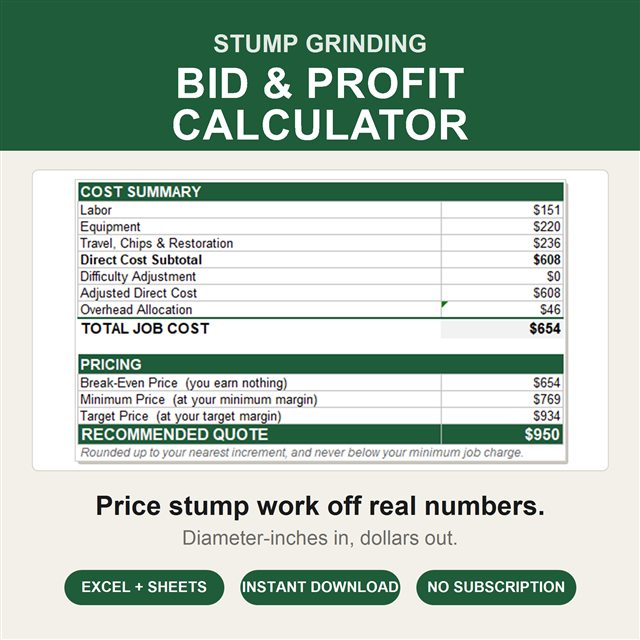
Stump grinding looks like the simplest job in tree work. One machine, one operator, a few stumps. That is exactly why it gets underpriced. The customer sees a small machine and a short visit. You see the trailer, the teeth, the drive, the rock you hit at eight inches, and the raking. The calculator above prices what you see, not what the customer sees.
1. Measure in diameter-inches
The industry unit for stump work is the diameter-inch: the width of the stump at ground level, including the root flare, in inches. Six stumps averaging 18 inches is 108 diameter-inches. Everything downstream, time, machine wear, price, scales with that number.
2. Know your grinding rate
Your grinding rate is how many diameter-inches your machine clears in an hour at a standard 4 to 6 inch depth. A compact tow-behind unit does 40 to 60. A larger self-propelled machine does 80 to 120. This number is the single biggest driver of your cost, and most operators have never measured it.
Time your next three jobs: grinder hours only, from first cut to last. Divide total diameter-inches by hours. Put that number in the calculator and your estimates will be right far more often than any rule of thumb.
3. Depth, soil and roots multiply the time
A standard grind takes the stump 4 inches below grade so grass can grow over it. Going 8 inches for a planting bed roughly adds a quarter to the grind time. Going 12 to 16 inches so a new tree can go in the same spot nearly doubles it. Rocky soil destroys teeth and slows the cut. Heavy surface roots that need chasing add passes far from the stump.
| Factor | Condition | Time multiplier |
|---|---|---|
| Depth | 4 inches, standard | 1.00 |
| 8 inches | 1.25 | |
| 12 inches | 1.55 | |
| 16 inches or more | 1.90 | |
| Soil | Normal | 1.00 |
| Some rock or gravel | 1.25 | |
| Heavy rock | 1.55 |
These multiply together. A 12-inch grind in gravel is 1.55 × 1.25, or almost double the standard time. Quote it as a standard grind and you will spend the afternoon working for free.
4. The machine costs more than fuel
A stump grinder costs money every hour it runs: fuel, the payment, insurance, servicing, and teeth. Tooth wear alone runs $5 to $12 an hour in normal soil and far more in rock. Add the truck and trailer that brought it and a realistic all-in machine rate is $45 to $65 per grinder hour. If you have been pricing the machine at fuel cost, this is where the missing money went.
5. Setup, moves and cleanup are real hours
Unloading, positioning at each stump, moving between them, and raking chips into a pile is often as much time as the grinding itself on small multi-stump jobs. Six stumps scattered across a back yard can cost an hour of moving before the first cut. Put it in as its own line so it never gets forgotten.
6. Price grinding separately from restoration
Hauling chips away, backfilling with topsoil, and seeding are different jobs with different material costs. Keep them out of the grinding price for two reasons. The customer can choose what they want, which makes your base price look competitive. And you can compare your grinding rate per diameter-inch straight against what other operators charge, because their quotes usually exclude restoration too.
7. Set a minimum and round up
One 10-inch stump is 10 diameter-inches. At $5 an inch that is $50, and it costs you more than $50 just to drive there. Every stump business needs a minimum job charge, typically $150 to $250, and a habit of rounding quotes up to a clean number.
Worked example
Six maple stumps, 18 inches average, ground 8 inches deep for a new bed, normal soil, open yard.
| 108 diameter-inches ÷ 60 per hour | 1.80 hrs |
| × 1.25 for 8-inch depth | 2.25 hrs |
| + 1.0 hr setup, moves, cleanup | 3.25 grinder hrs |
| Labor: 4.0 crew hrs (incl. 0.75 drive) × $38 | $152.00 |
| Machine: 3.25 hrs × $53 | $172.25 |
| Fuel and other | $15.00 |
| Overhead: 4.0 hrs × $12 | $48.00 |
| Total job cost | $387.25 |
|---|---|
| Target price at 30% margin (÷ 0.70) | $553.21 |
| Recommended quote (rounded up to $25) | $575 |
| Price per diameter-inch | $5.32 |
A "$400 for all six" quote, which sounds generous to the customer and plausible to the operator, is a 3% margin. One rock and the job loses money.
Common mistakes
- Pricing per stump instead of per inch. A 30-inch oak stump is nine times the grinding of a 10-inch one, not three times.
- Quoting from the driveway. Walk to each stump. Look for rock, sprinkler heads, roots and gate width. Each one changes the multiplier.
- Forgetting the utility locate. Grinding deeper than 4 inches near a house means calling 811. It is free, but the two-day wait is not, if you already promised a date.
- Leaving the chip pile unmentioned. A 24-inch stump makes about two cubic yards of chips. Tell the customer it stays unless they pay for haul-away, and write it on the quote.
Frequently asked questions
How much does stump grinding cost per inch?
Most operators charge $3 to $8 per diameter-inch with a minimum of $150 to $250 per visit. Depth, rock and access push the rate toward the top of that range.
How do you measure a stump for grinding?
Measure the widest point at ground level including the root flare. Multiply by the number of stumps for total diameter-inches.
How long does it take to grind a stump?
A mid-size grinder clears 50 to 80 diameter-inches per hour at standard depth. An 18-inch stump is about 15 to 25 minutes of grinding plus setup and cleanup.
Should chip removal be priced separately?
Yes. Chip haul-away, topsoil and seeding are separate line items with their own costs. Keeping them out of the grinding price makes your per-inch rate comparable and lets the customer choose.
Every default in the calculator is a placeholder. Grinding rates, wages, machine costs and dump fees vary by region and equipment. Replace them with your own numbers before you bid. This tool does not provide legal, tax, insurance or accounting advice.