The formula
A roof surface is the hypotenuse of a triangle whose base is the run (12 inches) and whose height is the rise. The multiplier is that hypotenuse divided by the run.
| Pitch | Multiplier | Area added | What it means on the roof |
|---|---|---|---|
| 2/12 | 1.014 | +1% | Nearly flat; membrane territory |
| 3/12 | 1.031 | +3% | Low slope, minimum for most shingles |
| 4/12 | 1.054 | +5% | Walkable |
| 5/12 | 1.083 | +8% | |
| 6/12 | 1.118 | +12% | Typical suburban |
| 7/12 | 1.158 | +16% | |
| 8/12 | 1.202 | +20% | Steep: harness, jacks, slower crew |
| 9/12 | 1.250 | +25% | |
| 10/12 | 1.302 | +30% | |
| 12/12 | 1.414 | +41% | 45 degrees |
From footprint to squares in three steps
- Footprint. Length × width of the building plus any dormers, porches and bumps that carry roof. 48 × 32 + 180 = 1,716 sq ft.
- Roof area. Footprint × multiplier. 1,716 × 1.118 = 1,918 sq ft.
- Squares. Roof area ÷ 100 = 19.2 squares. Add waste (10% simple gable, 15% hips and valleys) and round up: 22 squares to order.
What skipping the pitch costs
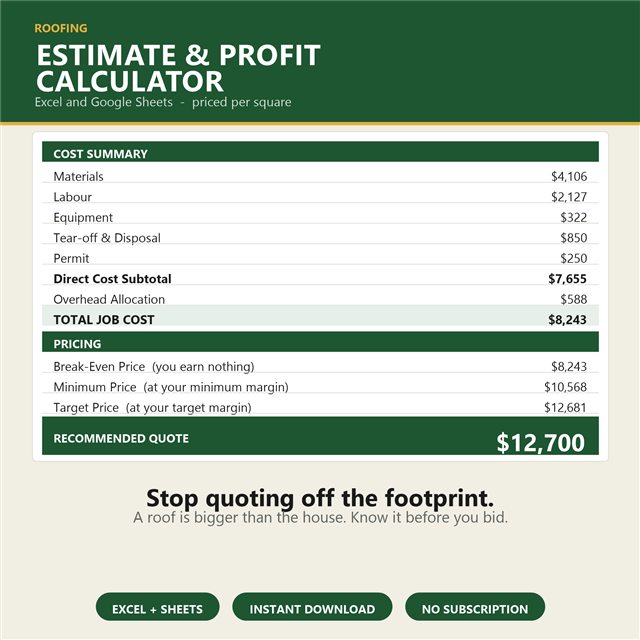
On this roof the pitch adds 2 squares. At a price of $662 a square that is $1,340 of revenue the estimate would have missed, and about a third of a crew-day of labour it would have under-planned. On a 10/12 roof of the same footprint the miss is 5 squares and over $3,000. The roofing estimate calculator shows this number on every job as "money the pitch found."
Finding the pitch without climbing
- Level and tape at the eave or in the attic. Hold a 12-inch level horizontal against a rafter; measure the vertical drop at the end. That drop in inches is the rise.
- Phone app. A clinometer app held flat on a shingle course from a ladder reads degrees; 26.6° is 6/12, 33.7° is 8/12, 45° is 12/12.
- From the gable end. Rise over half the span. A 32-foot-wide gable with an 8-foot ridge height above the eave is 8 ÷ 16 = 6/12.
Pitch also changes production, not just area
Above 7/12 the crew slows down: harnesses, roof jacks, staging shingles by hand. Many roofers cut their squares-per-day by a quarter on steep roofs and add a steep-roof charge per square. Put both in the estimate: the multiplier for the area, and a lower production rate for the labour.
Common mistakes
- Using the satellite footprint as roof area. It is always the footprint. Apply the multiplier.
- One waste factor for every roof. A cut-up hip roof with three dormers can waste 18%. A plain gable wastes 8%.
- Forgetting the extras. The porch roof, the bay window, the detached garage. Each one is footprint.